 LYNX SHARE
Pocket SuperSaw
Virtual analog synth with up to 12 detuned saws per voice, a sub oscillator, a 4-pole low-pass filter, three envelopes, an LFO, an arpeggiator, distortion and delay. Rebuilt from FL Studio Mobile's SuperSaw.
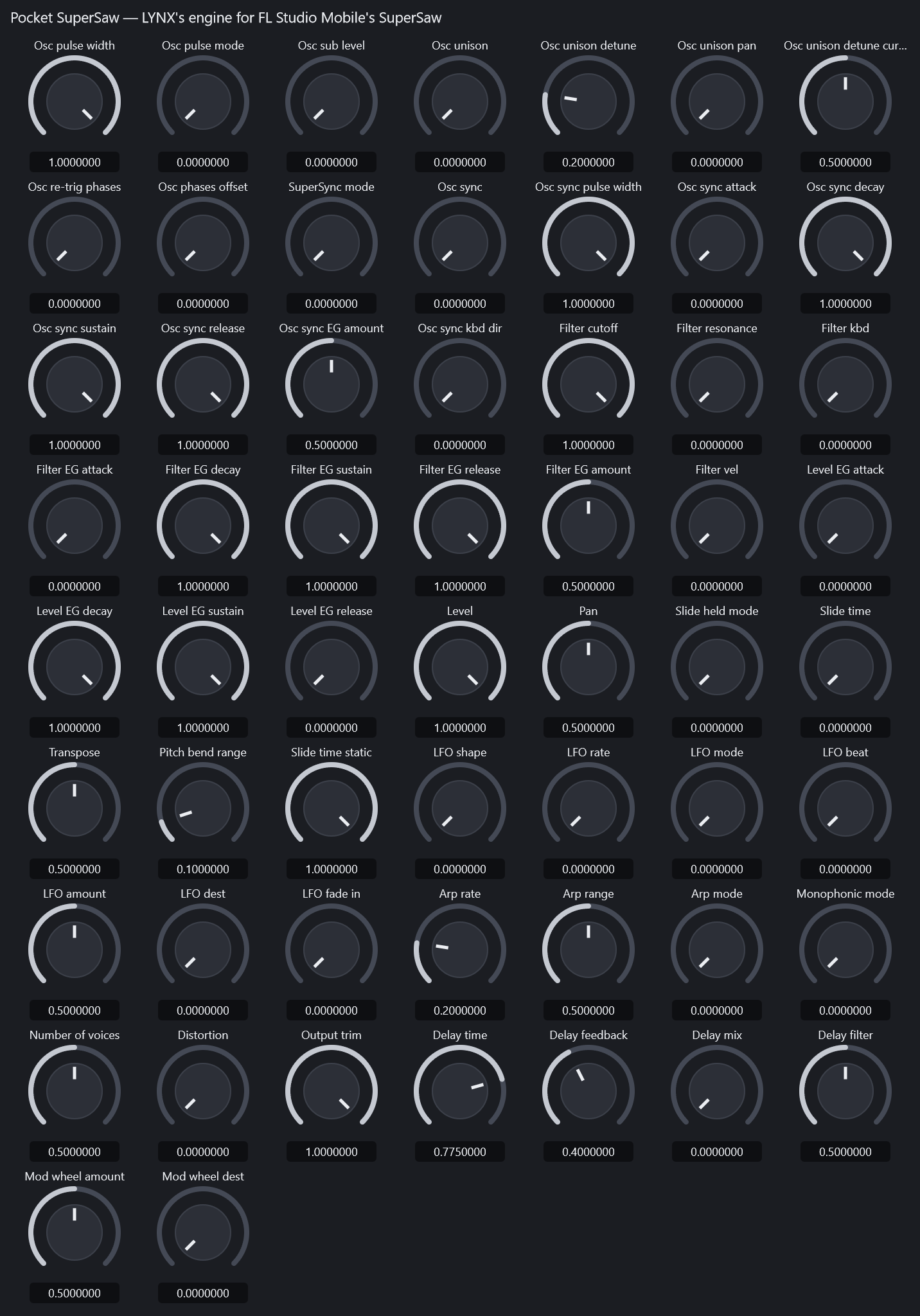
Pocket SuperSaw is a virtual analog synthesizer with up to 8 voices. Each voice is a stack of 1 to 12 detuned saw waves with a sub-octave saw, or the SuperSync oscillator, a train of pulses that sweeps like hard sync. It is the engine that FL Studio Mobile projects (.flm) load their SuperSaw module on, and it is also in the plugin picker under Pocket SuperSaw. A new channel starts from FL Studio Mobile's defaults. The page is a plain list of knobs, one per parameter (59 in all), not FL Studio Mobile's own panel.
Controls
| Control | What it does |
|---|---|
| Osc unison, Osc unison detune, Osc unison detune curve, Osc unison pan | Number of saws per voice (1 to 12), how far they are detuned (up to 100 cents), how the detune is spread across the saws, and how wide they are panned. |
| Osc pulse width, Osc pulse mode, Osc sub level | Pulse mode turns each saw into a pulse wave, with its width. Osc sub level is the level of the saw one octave down. |
| Osc re-trig phases, Osc phases offset | With re-trig on, every note starts the saws at the same phases, so the beating is the same on every note. Off: each note starts at random phases. |
| SuperSync mode, Osc sync, Osc sync pulse width, Osc sync attack / decay / sustain / release, Osc sync EG amount, Osc sync kbd dir | The SuperSync oscillator and its own envelope, which sweeps the sync amount. |
| Filter cutoff, Filter resonance, Filter kbd, Filter vel | A 4-pole ladder low-pass filter, up to 20 kHz, with keyboard and velocity tracking. |
| Filter EG attack / decay / sustain / release, Filter EG amount | The filter envelope. The amount is bipolar, -100 % to +100 %. |
| Level EG attack / decay / sustain / release, Level, Pan | The volume envelope and the output level and pan. Envelope times run from 0 to 31 seconds. |
| LFO shape, LFO rate, LFO mode, LFO beat, LFO amount, LFO dest, LFO fade in | One LFO per voice: Sine, Ramp, Square or Random; Free, One shot or Tempo sync. LFO dest picks Cutoff, Resonance, Pitch, Sync, Pulse width, Detune, Level or Pan. |
| Arp rate, Arp range, Arp mode | Arpeggiator: Off, Up, Down, Up-down, Up-down (ends twice) or Random, over up to 3 extra octaves. |
| Monophonic mode, Number of voices, Slide held mode, Slide time, Slide time static | Play one voice or up to 8, and how notes glide. |
| Transpose, Pitch bend range | Transpose by -12 to +12 semitones. The pitch wheel bends by 1 to 12 semitones. |
| Distortion, Output trim | A tanh distortion and an output trim of -18 to 0 dB. |
| Delay time, Delay feedback, Delay mix, Delay filter | A tempo-synced stereo delay, 1/4 beat to 1 beat, with a low-pass or high-pass filter in its loop. |
| Mod wheel amount, Mod wheel dest | What the mod wheel moves: Cutoff, Resonance, Sync, Pulse width, Detune, Level, Pan, LFO amount or LFO rate. |
Tips
- Every knob can be automated. The saws are band-limited, so high notes do not alias.
- Start phases and the Random LFO come from a generator owned by each instance, so a render never matches a given FL Studio Mobile render sample for sample. The energy and the spectrum do.
- The channel's pitch knob, fine tune, Mono and Porta and the Piano roll's slide notes act on the voices as they do on FL Studio's generators.